

We’ve all encountered them.
The executive who immediately points out why the new initiative won’t work.
We’ve all encountered them.
The team member who always seems to have “just one more” concern.
The family member who responds to your dream vacation with a list of objections.
After a while, it’s tempting to label these people as negative, resistant, difficult—or simply “Debbie (or Dave) Downer.”
Over the past few months, I’ve been traveling quite a bit. Whether I’m sitting in a boardroom, facilitating a leadership workshop, or sitting around a kitchen table with family and friends, I keep hearing versions of the same frustration:
“Why don’t they just get on board?”
“Why do they always have to point out what’s wrong?”
“Why can’t they get excited about the idea and jump in?”
No matter where I go in the world, people with ideas to make things work better seem to be wrestling with the same dynamic.
And it has me wondering whether many of us have been looking at these individuals the wrong way.
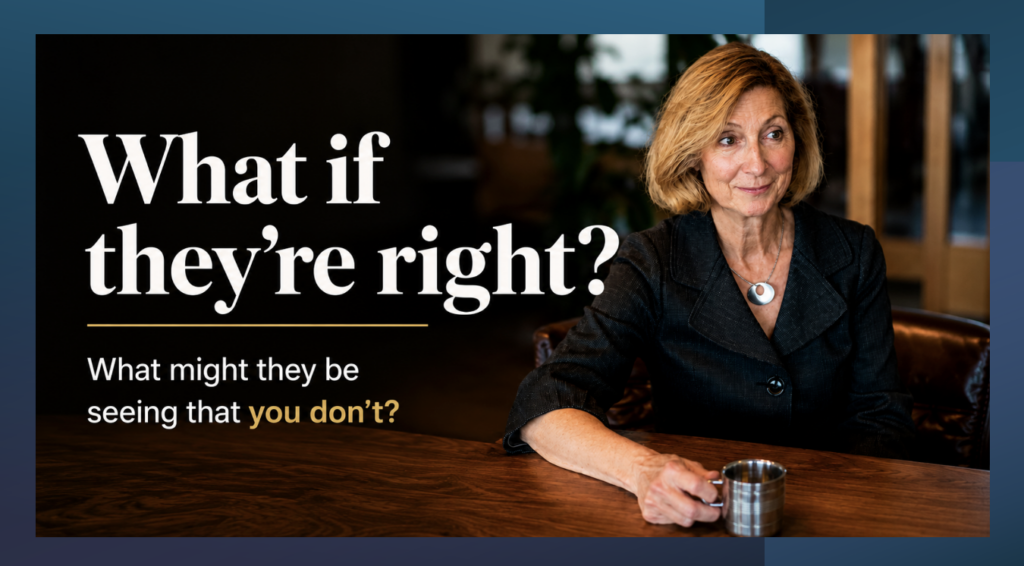
What if they aren’t trying to derail our ideas? What if they’re actually helping us see risk in a new way?
One of the concepts I explore in Fast Track Your Big Idea! is the idea of risk fingerprints. Just as no two people have identical fingerprints, no two people perceive and respond to risk in exactly the same way.
Some people naturally move quickly toward possibilities and action. Others instinctively scan for obstacles, unintended consequences, or implementation challenges. Some need more information before committing, while others want to make sure that their relationships, reputation, values, autonomy, or workload won’t be compromised.
Neither perspective is inherently right or wrong.
What’s fascinating is that it’s not just individuals who have risk fingerprints. Families, teams—and heck, entire organizations—develop shared patterns around how they perceive and engage with risk.
Problems arise when people with very different risk fingerprints try to drive a new strategy forward without recognizing those differences.
A big idea only succeeds if the right people take action. But when people are asked to do something new, their brains naturally assess the risks involved and attempt to protect them.
The people you see as “pushing back” may not be resisting your idea. They may simply be protecting something they value.
A few months ago, I was facilitating a discussion with senior leaders. One executive was starting to be perceived as the “Debbie Downer” in the room. Every time the new strategy was discussed, she raised concerns, and the eye rolls around the table were starting to be unmistakable.
But as I unpacked her objections, it became clear that she wasn’t resisting the strategy at all—in fact, she loved it! But she understood something the rest of the leadership team didn’t want to hear: a critical customer-facing department simply lacked the capacity to execute the proposed volume.
By creating space for this leader to openly discuss the risks and surface the issue early, the leadership team was able to adjust staffing and timelines before launch and avoid a customer-satisfaction nightmare.
What initially looked like resistance turned out to be valuable intelligence.
Why Pushback Matters
When people see risks but don’t feel comfortable discussing them openly, their concerns don’t disappear. They go underground.
People nod silently in meetings but share their concerns later in hallways, cubicles, or around the dinner table. Anxiety rises. People hesitate. Decisions slow.
Leaders often mistake silence for agreement. Eventually, however, they get blindsided by the concerns and resistance that had been there all along.
I’ve come to believe that not talking about risk is risky.
The healthiest teams I’ve worked with make conversations about risk a normal part of their rhythm. They create space for people to challenge assumptions, surface observations, and discuss possible unintended consequences without fear of being labeled negative or disloyal.
Leaders often worry that conversations about risk will slow progress. In my experience, they do exactly the opposite.
When people feel heard, anxiety decreases. Trust increases. Decisions happen faster. Teams adapt more quickly because concerns surface before they become barriers. People are also more willing to propose alternative approaches and identify new windows of opportunity.
Why does this matter now?
Because the challenges leaders face are becoming increasingly complex.
It takes courage to lead in the face of uncertainty. But I believe it also takes courage to listen.
- The humility to invite perspectives that challenge our assumptions.
- The discipline to hear concerns without becoming defensive.
- The curiosity to understand what others may be seeing that we don’t.
Too often, leaders surround themselves with people who think the way they do. Yet in a complex world, we actually need more diverse perspectives—including those who see risks that others may miss.
The goal isn’t to eliminate differences in how we see risk. The goal is to leverage them.
Questions to Ask When You Feel “Pushback”
The next time someone objects to your idea, get curious. Consider:
- What does this person value that they might be trying to protect?
- What risk or unintended consequence do they see that I don’t?
- What assumptions am I making that others may not share?
- What information would help this person move forward?
- What might happen if this concern turns out to be valid?
Of course, getting stuck in endless analysis isn’t productive. Teams still need to make decisions without having perfect answers. In many situations, “minimum viable” answers will allow organizations to move faster, learn quickly, and adapt.
But dismissing every skeptic as “Debbie or Dave Downer” may cause leaders to overlook information their strategy desperately needs if they want their big idea to stick.
A Challenge: Get Curious
The next time you truly want people to take action with you, stop and ask:
“What risks or concerns haven’t we discussed yet that we should?”
Then really listen.
You may discover that the person you were most tempted to dismiss is providing the very insight your team needs most.
I’d love to hear your experience.
Has someone you initially viewed as resistant ultimately helped you avoid a problem down the road?
-—Susan
P.S. If you’re wrestling with a new initiative, check out my new book, Fast Track Your Big Idea! Navigate Risk, Move People to Action, and Avoid Your Strategy Going Off Course. There are over 20+ practical tools you can apply immediately.
This article is part of my “Fast Track Insights” newsletter, providing practical ideas whether you are driving a new strategy or getting one back on track. I want to help you avoid common mistakes. Subscribe to receive practical insights once or twice a month.